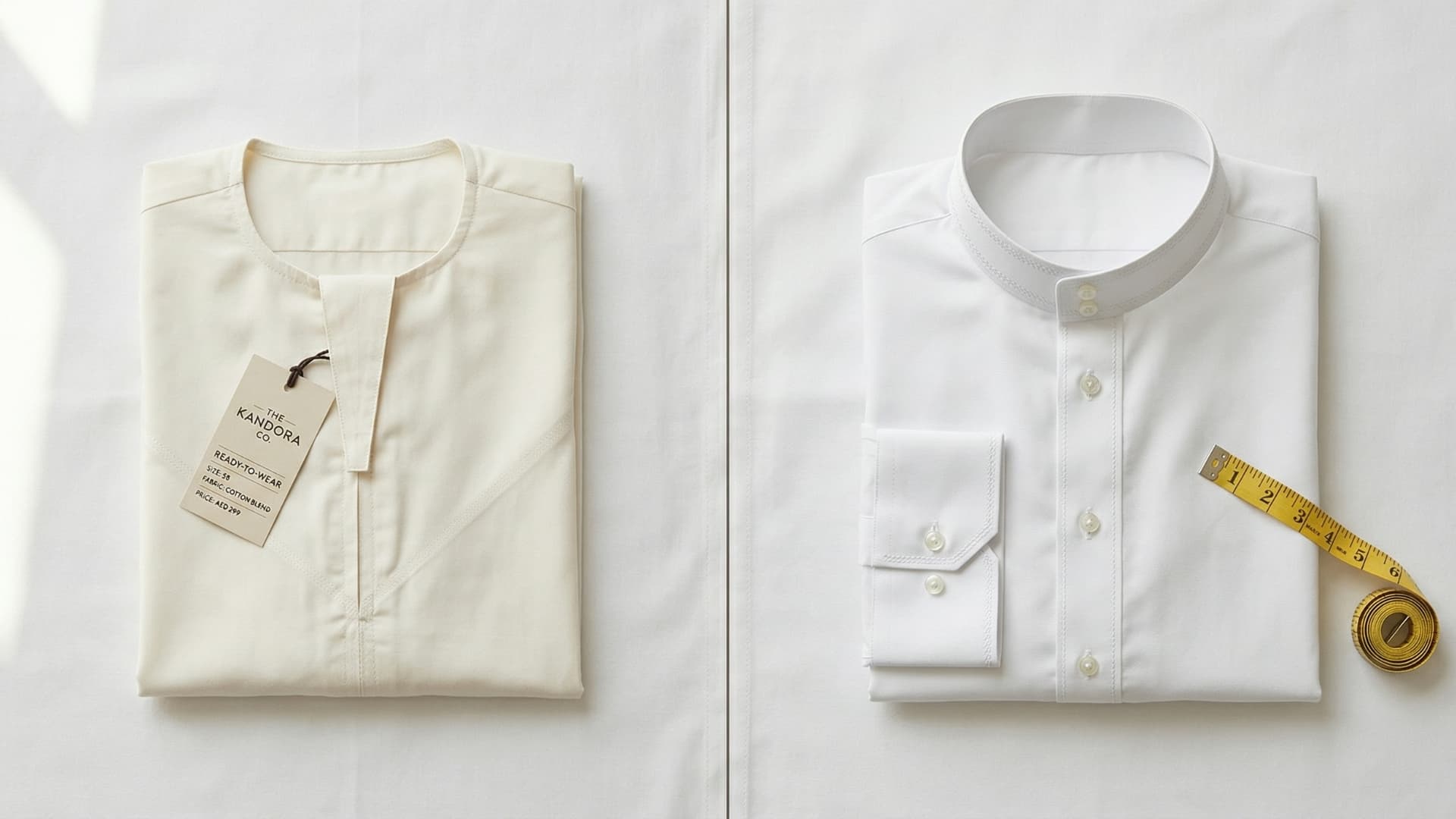
Custom Tailored vs Ready-Made Kandora: What Actually Makes the Difference
Shabab Al Yola Teams
Table of Contents
Table of Contents
Custom Tailored vs Ready-Made Kandora: What Actually Makes the Difference
Walk into any mall in Abu Dhabi and you will find racks of ready-made kandoras in various sizes, colors, and price points. They look decent on the hanger. Some of them even look decent on the body, at first glance. But spend a week wearing one versus a week wearing a kandora made specifically for your measurements, and the difference becomes impossible to ignore.
This is not about budget versus luxury. It is about understanding what you are actually getting in each case, and deciding which one makes sense for your lifestyle, your body, and how you want to present yourself.
What Ready-Made Kandoras Actually Offer
Ready-made kandoras exist for good reason. They are widely available, quick to buy, and cover a broad range of sizes. For someone who needs a kandora urgently, is buying one as a backup, or is wearing traditional dress occasionally rather than daily, a ready-made option gets the job done.
Most ready-made kandoras are produced in standard sizes, small, medium, large, and so on, with set measurements for chest, length, and sleeve. The construction is generally consistent within each brand, and the fabrics used are serviceable, often cotton blends that wash reasonably well and hold their shape through regular wear.
The price point is also genuinely lower. You can walk out with a ready-made kandora for a fraction of what a custom piece costs, and for some buyers, that makes perfect sense.
The limitations, however, show up quickly.
Where Ready-Made Falls Short
The fundamental problem with ready-made sizing is that human bodies do not follow standard templates. A man who fits a large in chest measurement may have a medium-length arm, narrower shoulders than the pattern allows for, or a height that puts the hem at an awkward position. Standard sizes accommodate the average, not the individual.
On a kandora specifically, fit issues are very visible. A shoulder seam that sits too far down the arm throws off the entire silhouette. A chest that is too wide creates extra fabric that bunches and pulls. A length that lands even two or three centimeters off looks noticeably wrong against the ankle.
Beyond fit, ready-made kandoras typically use mid-range fabrics chosen for cost efficiency rather than quality. The fabric may look fine in the shop but soften unevenly after washing, lose its brightness faster, or feel noticeably heavier and less breathable during Abu Dhabi summers.
The collar stitching, button quality, and internal finishing on most ready-made pieces are also done at speed rather than with care. These details do not jump out immediately but they affect how the garment holds up over months of wear.
What Custom Tailoring Actually Involves
When you order a custom kandora from a tailor, the process starts with measurements, not a guess at your size, but specific numbers taken at your shoulders, chest, waist, wrist, and full height. These measurements become the pattern for your garment, meaning every cut is made for your body specifically.
From there, you choose your fabric. A good tailor will have a range of options and will be able to explain the differences between them, how each one feels, how it performs in different weather, how it washes, and how it drapes on the body. This conversation alone is something you never get when pulling a kandora off a retail rack. For those seeking premium options, exploring a made-to-measure kandora collection in Abu Dhabi offers access to fabrics and craftsmanship tailored to individual needs.
The construction process then follows your pattern. The collar is shaped to sit correctly on your neck. The sleeves are cut to your arm length. The hem hits at exactly the right point. Buttons are placed according to your specific chest measurement rather than a standard spacing template.
Most tailors also offer a fitting appointment before the final garment is completed, where you can identify any small adjustments needed, a sleeve that needs shortening, a collar that needs slightly more space, a chest panel that can be taken in slightly for a cleaner line.
The Fabric Difference Is Bigger Than Most People Expect
One of the most significant but least talked-about differences between custom and ready-made kandoras is the fabric itself.
Custom tailors, particularly those working at a serious level, source their fabrics independently and give clients the option to choose. This means access to higher-grade materials, including fine Japanese fabrics that are not typically used in mass-produced kandoras.
Japanese cotton and cotton blends are known for their tight weave, smooth surface, consistent whiteness, and durability over repeated washing. They feel lighter on the skin, breathe better in heat, and hold their structure far longer than the standard fabrics used in most off-the-shelf kandoras.
When you wear a kandora made from genuinely good fabric, it shows. The color is brighter, the drape is cleaner, and the garment stays looking fresh for much longer. This is a direct result of where the fabric comes from and how it was selected, something only a custom process gives you full control over. Working with Abu Dhabi's home of traditional tailoring ensures access to these premium materials and expert guidance.
The Cost Conversation: Is It Actually Worth Paying More?
This is the question most people are thinking but not always asking directly.
A ready-made kandora might cost anywhere from AED 80 to AED 250 depending on the brand and fabric. A custom kandora from a quality tailor in Abu Dhabi typically starts higher and goes up depending on fabric choice and complexity.
But the comparison is not as simple as the upfront price. A well-made custom kandora, cared for properly, can last several years without losing its shape, brightness, or structure. A ready-made kandora in the same period often needs replacing after heavy use because the fabric fades, the stitching gives, or the fit issues that were manageable at first become more pronounced as the garment ages.
Over two or three years, buying two or three replacement ready-made kandoras versus one custom piece that holds up brings the actual cost difference much closer than it first appears.
There is also the question of value beyond money. If you wear a kandora daily, as a professional, as part of your cultural identity, in settings where your presentation matters, the confidence and comfort that come from a garment that genuinely fits your body and is made from quality material is not a small thing.
When Ready-Made Makes Sense
Custom tailoring is not the right answer for every situation, and it is worth being honest about that.
If you are buying a kandora for occasional wear, a visit, a short trip, a one-time event, a ready-made option is a practical choice. Similarly, if you are buying for a child who will grow out of the garment quickly, the investment in custom tailoring does not make the same financial sense.
Ready-made kandoras are also fine as everyday backup pieces when your primary wardrobe is at the laundry or when you need something quickly for an unplanned occasion. Having one or two on hand for convenience is not a compromise, it is just being practical.
The distinction is simple: for garments you wear regularly, in situations where your appearance matters, and on a body that does not fit neatly into standard sizing, custom is the better path. For everything else, ready-made fills the gap adequately.
What to Look for If You Go Custom
Not all tailors in Abu Dhabi work at the same level, and the process of choosing one matters.
Look for a tailor who takes detailed measurements rather than estimating by eye. Ask to see fabric samples and ask questions about where the fabric comes from. A tailor who knows their materials will be able to answer those questions clearly.
Ask about the fitting process. A good tailor builds in at least one fitting before completing the garment. This step is what separates a truly well-made piece from one that is custom-measured but not custom-adjusted.
Pay attention to the finishing details, the collar, the cuffs, the button stitching, and the internal seams. These are where the quality of a tailor's work is most visible, and they are also the areas that affect how a kandora holds up over time. For those building a complete traditional wardrobe, pairing your custom kandora with classic thobe styles for men in the UAE ensures consistency in quality and fit across your entire collection.
The Standard You Set for Yourself
A kandora is the garment most Emirati and Gulf men are seen in every single day. It is the first thing people notice, the thing that shapes how you carry yourself, and the thing you reach for every morning. Getting that garment right is not vanity, it is a standard.
If you are ready to experience what a properly made kandora actually feels like, explore our made-to-measure options at Shabab Al Yola, where every piece starts with your measurements and ends with a garment built specifically for you.
For those who want the full traditional look, our classic styles are made with the same commitment to fit and fabric that goes into every garment we produce.
At Shabab Al Yola, we have spent over 15 years doing one thing: making garments that fit the man wearing them, not the other way around.