Getting Your Kandora Fit Right: What the Measurements Actually Mean
Shabab Al Yola Teams
Table of Contents
Table of Contents
Getting Your Kandora Fit Right: What the Measurements Actually Mean
Most men who wear a kandora daily have never had one properly measured for them. They know their rough size, they have bought from the same place for years, and they have quietly adjusted to a garment that almost fits. The shoulder sits slightly off. The chest has a bit more room than it needs. The length is close but not quite right.
None of these things are dramatic on their own. But together, they change how a kandora looks and how it feels to wear throughout the day. A kandora that fits correctly sits differently on the body — it moves with you rather than around you, and the difference is visible from across a room.
This guide breaks down what the key measurements actually mean, how each one affects the finished garment, and what to expect when you go through a proper tailoring appointment in Abu Dhabi.
Why Standard Sizing Does Not Work for a Kandora
Western clothing uses standard sizing because the garments are designed to allow significant variation within each size. A t-shirt in large works across a wide range of body types because the cut has enough give built in.
A kandora does not work this way. It is a structured garment with a clean, close silhouette. Every measurement point has a direct and visible effect on how the finished piece looks. When the shoulder measurement is off by two centimeters, you see it. When the chest is cut too wide, the fabric pools and pulls. When the length is even slightly wrong, the entire proportion of the garment shifts.
This is why tailoring a kandora to your specific body is not a luxury — it is what the garment requires to look the way it is supposed to look. If you want to see what a properly made kandora looks like before your first appointment, browse the premium kandoras for men in Abu Dhabi at Shabab Al Yola to get a clear picture of the standard you should be aiming for.
The Measurements That Matter Most
Shoulder Width
This is arguably the most important measurement on a kandora. The shoulder seam should sit at the exact edge of your shoulder — not on top of it, not falling down your arm. When this measurement is right, the rest of the garment falls into place naturally. When it is wrong, nothing else can fully compensate.
A shoulder seam that sits too wide makes the chest panel hang loosely and causes the sleeves to droop. One that is too narrow pulls the chest forward and restricts arm movement. Both issues are immediately visible and both trace directly back to this single measurement.
Chest Circumference
The chest measurement determines how much room the kandora has through the torso. For a kandora, you want a clean fit — enough room to move and breathe comfortably, but not so much that the front panel billows or the sides hang loose.
A good tailor adds a specific amount of ease to the chest measurement depending on the fabric weight and the client's preference. Heavier fabrics need slightly more ease because they drape with more structure. Lighter fabrics sit closer to the body naturally. Understanding this distinction is part of what separates a skilled tailor from someone who simply follows a formula.
Sleeve Length
Sleeve length on a kandora is measured from the shoulder seam to the wrist. The finished sleeve should sit just at the wrist bone — not riding up the forearm, not covering the hand.
This measurement is one of the most commonly wrong on ready-made kandoras because arm length varies significantly between individuals of the same overall size. A man who is medium height with longer arms will find that most standard sleeves are consistently short. A taller man with proportionally shorter arms faces the opposite problem.
Getting this measurement right makes an immediate difference in how polished the finished look is, particularly when the cuffs are visible at a formal occasion.
Garment Length
The length of a kandora is measured from the top of the shoulder to the hem. Traditionally, the kandora falls to the ankle — specifically to a point just above where the foot meets the floor, allowing clean movement without the hem dragging.
Height alone does not determine this measurement accurately. The proportion of a person's torso to their legs affects where the hem lands relative to the floor. A tailor takes this measurement with the client standing in their usual footwear to get a precise reading that accounts for how the garment will actually be worn.
A hem that is even three or four centimeters too long drags and picks up dust. One that is too short exposes the ankle in a way that looks unfinished. The correct length lands cleanly and consistently regardless of how the wearer stands or moves.
Collar Size and Style
The collar is the most visible part of a kandora at close range and the point where individual variation matters most. Collar size is measured around the neck with a small amount of ease added — enough that the collar sits comfortably without being loose or tight.
Beyond the size, the collar style affects how the kandora frames the face and neck. A higher collar with a tighter band creates a more formal look. A lower, more open collar is better suited to daily wear and warmer weather. These choices are discussed during the tailoring appointment and depend on both personal preference and face shape.
What Happens During a Tailoring Appointment
If you have never been through a proper tailoring appointment for a kandora, knowing what to expect makes the process much smoother.
The appointment typically starts with a conversation about how you intend to wear the garment — daily wear, formal occasions, or both. This affects fabric recommendations, collar choices, and the amount of ease built into the cut.
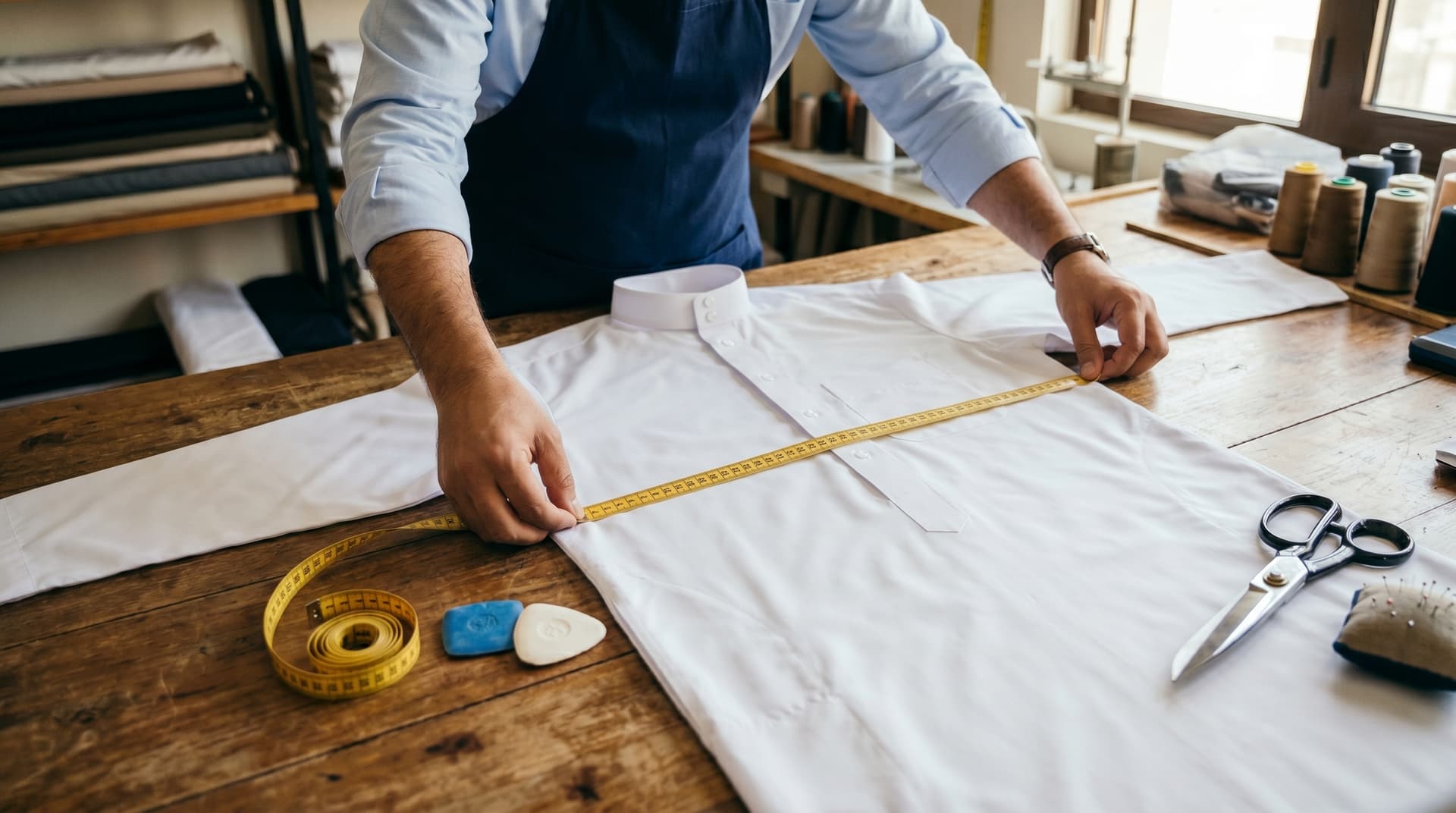
Measurements are then taken with you standing naturally in your regular footwear. A skilled tailor takes between eight and twelve measurements depending on the garment and the level of detail required. Each measurement is recorded and used to build your personal pattern.
Fabric selection follows, where you choose from available materials based on your preferences for weight, texture, and finish. A good tailor will guide this conversation based on your intended use and Abu Dhabi's climate requirements.
Most tailors schedule a fitting appointment after the initial cut is complete. This is where small adjustments are made before the garment is finished — a sleeve shortened by half a centimeter, a collar adjusted slightly, a side seam taken in for a cleaner line. This step is what takes a well-measured kandora and makes it a perfectly fitted one.
Common Fit Problems and What Causes Them
Even with good intentions, fit issues come up. Knowing what causes them helps you identify and communicate the problem clearly during a fitting.
Pulling across the chest usually means the chest measurement was taken too tight or the ease allowance was too small. The fix is letting out the side seams slightly.
Bunching at the shoulders is almost always a shoulder width issue. If the seam sits too far out, the excess fabric has nowhere to go and folds at the top of the arm.
An uneven hem can result from posture differences — one hip slightly higher than the other, or a slight lean in the standing position. A good tailor checks hem evenness with the client standing naturally rather than in a deliberately straight posture.
A collar that gaps or pulls usually means the neck measurement was taken incorrectly or the collar band was cut without enough ease. This is one of the most uncomfortable fit problems and one of the easiest to fix at the fitting stage.
Sleeves that twist forward happen when the sleeve is set into the armhole at the wrong angle. This is a construction issue rather than a measurement issue and requires resetting the sleeve — something that should be caught and corrected at the fitting.
How Your Body Changes Over Time
One thing many men do not account for is that body measurements change. Weight fluctuations, posture shifts, and changes in physical activity all affect how a kandora fits over time.
A kandora that fit perfectly two years ago may now feel tight across the chest or loose through the shoulders. Rather than replacing the garment entirely, a skilled tailor can often let out or take in seams to bring the fit back to where it should be — provided the original construction included enough seam allowance for adjustments.
This is another reason why quality construction matters. A kandora built with proper seam allowances can be adjusted as your body changes. One sewn with minimal seam allowance cannot be let out at all, which means a single size change makes it unwearable.
A lightweight faneela undershirt worn beneath your kandora also plays a small but practical role in how the outer garment fits and feels over time — it protects the fabric from direct contact with the skin, reduces the load on the kandora through heavy wear days, and helps the outer garment maintain its shape and freshness for longer.
Completing the Look from the Ground Up
A perfectly fitted kandora is the foundation, but the full picture includes everything worn with it. The accessories you choose above the kandora complete the look from the collar upward. A well-chosen agal and ghutra, sized and draped correctly, brings the entire outfit together in a way that no amount of tailoring on the kandora alone can achieve.
The same attention you give to getting your kandora measurements right should go into every layer of the traditional look — from the undershirt to the headwear — because each piece affects how the whole comes together.
The Tailor's Role Is to Fit You, Not the Pattern
A good tailor does not ask your body to conform to a standard pattern. They build the pattern around your body. This distinction sounds simple but it is what separates a garment that looks made-for-you from one that looks close enough.
At Shabab Al Yola — Abu Dhabi's trusted tailor since 2009, every kandora starts with a conversation and ends with a garment cut specifically for the person wearing it. That process has been the same since we opened, and it is the reason our clients come back season after season.