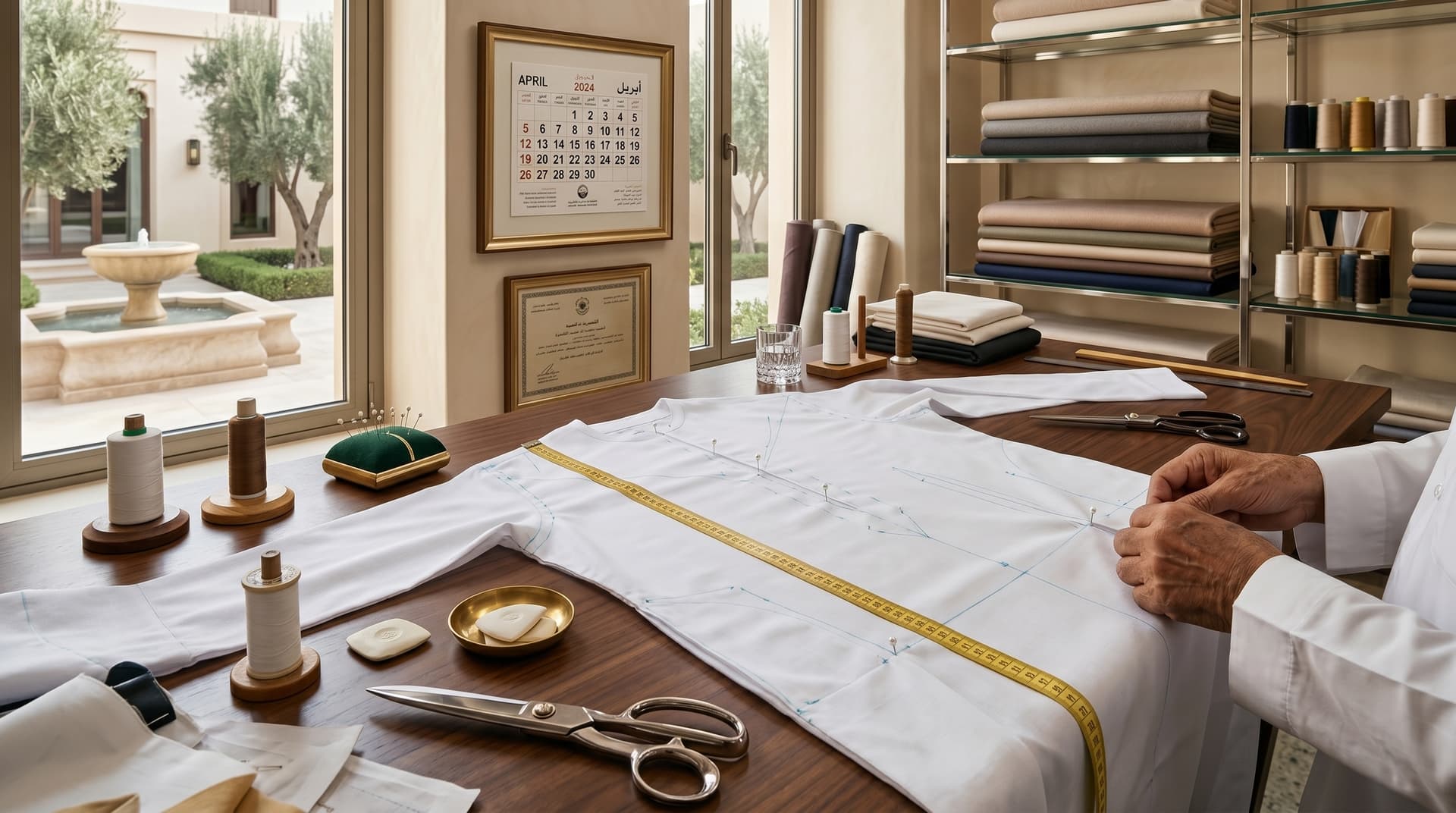
How Long Does a Custom Kandora Take to Make in Abu Dhabi
Shabab Al Yola Teams
Table of Contents
Table of Contents
How Long Does a Custom Kandora Take to Make in Abu Dhabi
One of the most practical questions any man asks before ordering a custom kandora is also one of the least answered clearly: how long is this actually going to take?
It is a fair question. If you have a wedding in two weeks, a National Day event in ten days, or Eid approaching and you want a new formal kandora ready in time, the answer matters enormously. Going to a tailor without understanding the timeline means you might end up disappointed, rushed, or, worst case, without the garment you needed for the occasion that prompted you to order it in the first place.
This guide breaks down the full process from first appointment to final collection, explains what affects the timeline at each stage, and helps you plan your order so you get what you need when you need it.
At Shabab Al Yola we have been producing custom kandoras in Abu Dhabi since 2009, and understanding what our clients need and when they need it has always been central to how we work.
The Stages of Making a Custom Kandora
A custom kandora does not appear in one continuous step. It moves through a series of distinct stages, each of which takes time and contributes to the final result. Understanding these stages gives you a realistic picture of where the time goes and why rushing any of them produces a worse outcome.
Stage One: The Initial Consultation and Measurement Appointment
This is where everything starts. The consultation involves a conversation about your intended use, fabric preferences, collar style, and any specific requirements you have. Measurements are taken and recorded. Fabric is selected.
This stage takes between thirty minutes and one hour depending on how many decisions need to be made. If you come in with a clear sense of what you want, the process is faster. If you are exploring options and need guidance, the conversation takes longer, and that time is well spent because the decisions made here shape everything that follows.
Stage Two: Pattern Drafting
Once measurements are taken, the tailor or their pattern maker drafts the pattern for your specific body. For a returning client whose measurements are already on file, this stage is quick. For a new client, drafting a precise pattern from fresh measurements takes more time and care.
Pattern drafting is done before any cutting begins. It is the stage that translates your measurements into a physical guide for the scissors and sewing machine. Errors at this stage multiply through the rest of the process, which is why a careful tailor does not rush it.
Stage Three: Cutting the Fabric
With the pattern drafted, the fabric is cut. This is a precise process, kandora fabric is cut in multiple panels that need to align correctly at the seams when joined. The collar, cuffs, and facing are cut separately and need to match the main fabric in grain direction and alignment.
Cutting takes less time than pattern drafting but demands the same level of precision. A cut that is even slightly off cannot be corrected later without wasting fabric and starting again.
Stage Four: Construction and Stitching
This is the longest stage in terms of active work. The cut panels are assembled, the collar is constructed and attached, the sleeves are set in, the side seams are joined, and the hem is finished. Each step is done in a specific sequence because the order of construction affects how seams align and how the finished garment sits.
For a kandora with embroidery, on the collar, cuffs, or front panel, the embroidery work is done during this stage before the final assembly closes off access to those areas. Embroidery adds time depending on complexity and whether it is handmade or machine-done.
Stage Five: The Fitting Appointment
Once the initial construction is complete, the kandora is ready for a fitting. You try it on and the tailor assesses the fit across all the key points: shoulder seam position, chest ease, sleeve length, collar height, and hem level.
At this appointment, adjustments are marked and noted. Small corrections, a sleeve shortened by a centimeter, a side seam taken in slightly, are common and expected. This fitting is not a sign that something went wrong. It is the step that takes a well-measured kandora and makes it a perfectly fitted one.
Stage Six: Final Adjustments and Finishing
After the fitting, the marked adjustments are made. The garment is then pressed, any finishing details are completed, and the kandora is prepared for collection. This final stage is typically the quickest but it cannot be skipped, pressing and finishing are what give a completed kandora its clean, ready-to-wear appearance.
How Long Does the Full Process Take?
With all stages accounted for, the typical timeline for a custom kandora in Abu Dhabi runs between five and ten working days for a straightforward piece with standard construction.
This timeline assumes:
- Fabric is in stock and does not need to be ordered
- The design is standard without complex embroidery
- The tailor's schedule has capacity at the time of order
- The client is available for a fitting appointment within the construction window
For kandoras with handmade embroidery, additional decorative detailing, or very fine fabric that requires more careful handling, the timeline extends to two to three weeks. For very simple pieces at a tailor with immediate capacity, it can be done in three to four working days, but this is the exception rather than the standard, and pushing for the fastest possible turnaround usually means the fitting stage gets compressed or skipped entirely, which affects the final result.
What Makes the Timeline Longer
Several factors push the timeline beyond the standard window, and knowing them in advance helps you plan more effectively.
Seasonal demand is the biggest variable. In the weeks leading up to Eid Al Fitr, Eid Al Adha, UAE National Day, and the wedding season, tailoring shops in Abu Dhabi experience a significant spike in orders. Tailors who might normally complete a kandora in five days may be looking at three weeks during peak periods because the workload ahead of your order is already substantial.
If you need a kandora for a specific occasion, placing your order at least three to four weeks before the date during peak seasons gives you comfortable margin. During quieter periods, two weeks is usually sufficient.
Fabric availability matters when the fabric you want is not in stock at the tailor and needs to be sourced or ordered. Premium Japanese fabrics are not always held in large quantities at every tailor, and sourcing the specific weight or finish you want can add several days to the timeline.
Embroidery complexity adds significant time for handmade work. A collar with detailed hand embroidery from a skilled artisan can take several days on its own, separate from the tailoring work on the rest of the garment.
Fitting availability also plays a role. If your schedule makes it difficult to come in for a fitting during the tailor's working hours, the gap between the initial construction and the final adjustments extends the overall timeline.
Planning Your Order Around an Occasion
The most common reason men are asking about timelines is that they have a specific occasion in mind and want to know whether they can get a kandora made in time. Here is a practical framework for planning.
For Eid: Place your order at least four weeks before Eid begins. Tailors in Abu Dhabi are consistently overwhelmed in the final two weeks before each Eid, and orders placed in that window frequently cannot be completed to the standard they deserve. Four weeks gives you comfortable margin for the full process including a proper fitting.
For weddings: If you know about the wedding date in advance, ordering six weeks out is ideal. This gives you time for a relaxed consultation, a proper fitting, and any adjustments without any pressure. Three weeks is the minimum for a standard kandora without embroidery.
For National Day: Orders placed in November for December 2nd events are the most time-sensitive. Many tailors reach full capacity by mid-November. Place your order in late October if possible.
For an unplanned occasion: If something comes up with less than a week's notice, a fully custom kandora may not be achievable in that window. A quality tailor may be able to produce a simpler piece quickly, or can guide you toward a ready-made option that they can alter to improve the fit within a shorter timeframe.
What to Bring to Your First Appointment
Coming to your first tailoring appointment prepared makes the process faster and more productive.
Wear the footwear you plan to wear with the kandora, this affects the length measurement directly. If you have a previous kandora whose fit you were happy with, bring it. A tailor can take reference measurements from a garment you liked and use them as a starting point for your new piece.
If you have specific occasions in mind, mention them at the start of the consultation. The tailor's fabric and style recommendations will be better targeted when they know whether you need a daily wear piece, a formal kandora, or something in between.
Browse the custom kandora collection at Shabab Al Yola before your appointment to get a sense of the styles and fabric options available, so you arrive with a clearer idea of what direction you want to go.
The Time Is Part of the Quality
A custom kandora takes the time it takes because making it properly requires each stage to be done with care. The consultation shapes the right choices. The pattern drafting translates your body into a precise guide. The construction builds the garment correctly. The fitting catches what needs correction. The finishing makes it ready to wear.
Skipping or rushing any of these stages produces a result that looks close but never quite right, and on a garment as visible and as personally significant as a kandora, close is not good enough.
Plan ahead, communicate your timeline clearly with your tailor from the first appointment, and give the process the time it needs. The result is a kandora that fits correctly, looks exactly right, and is ready for the occasion you ordered it for.
Visit Shabab Al Yola, Abu Dhabi's trusted kandora tailor since 2009 to book your consultation and discuss your timeline with our team directly.