How to Pick the Right Kandora for Your Skin Tone
Shabab Al Yola Teams
Table of Contents
Table of Contents
How to Pick the Right Kandora for Your Skin Tone
Walk into any tailoring shop in Abu Dhabi and you will find kandoras in white. Just white. And yet two men can walk out wearing what appears to be the same color and look completely different — one looking sharp, bright, and well put together, and the other looking somehow washed out or dull without being able to explain exactly why.
The difference is almost never about the cut or the fit. It is about the specific shade and finish of the white fabric, and how it interacts with the wearer's skin tone. White is not a single color. It exists on a spectrum of undertones — cool, warm, and neutral — and the finishing processes applied to kandora fabric during manufacturing push each piece further along that spectrum in ways that are visible on the body even when they are not obvious on the hanger.
Understanding this is one of the most underrated aspects of choosing a kandora, and getting it right makes an immediate and visible difference to how the whole look comes together.
At Shabab Al Yola we work with clients across a full range of skin tones every day, and helping men find the white that works specifically for them is part of what a proper tailoring consultation covers. This guide gives you the foundation to walk into that conversation knowing what to look for.
Why White Is Not Just White
The idea that all white fabric is the same color is the starting misconception most men carry into a kandora purchase. In reality, white fabric exists across a wide tonal range depending on how the fiber was treated during manufacturing.
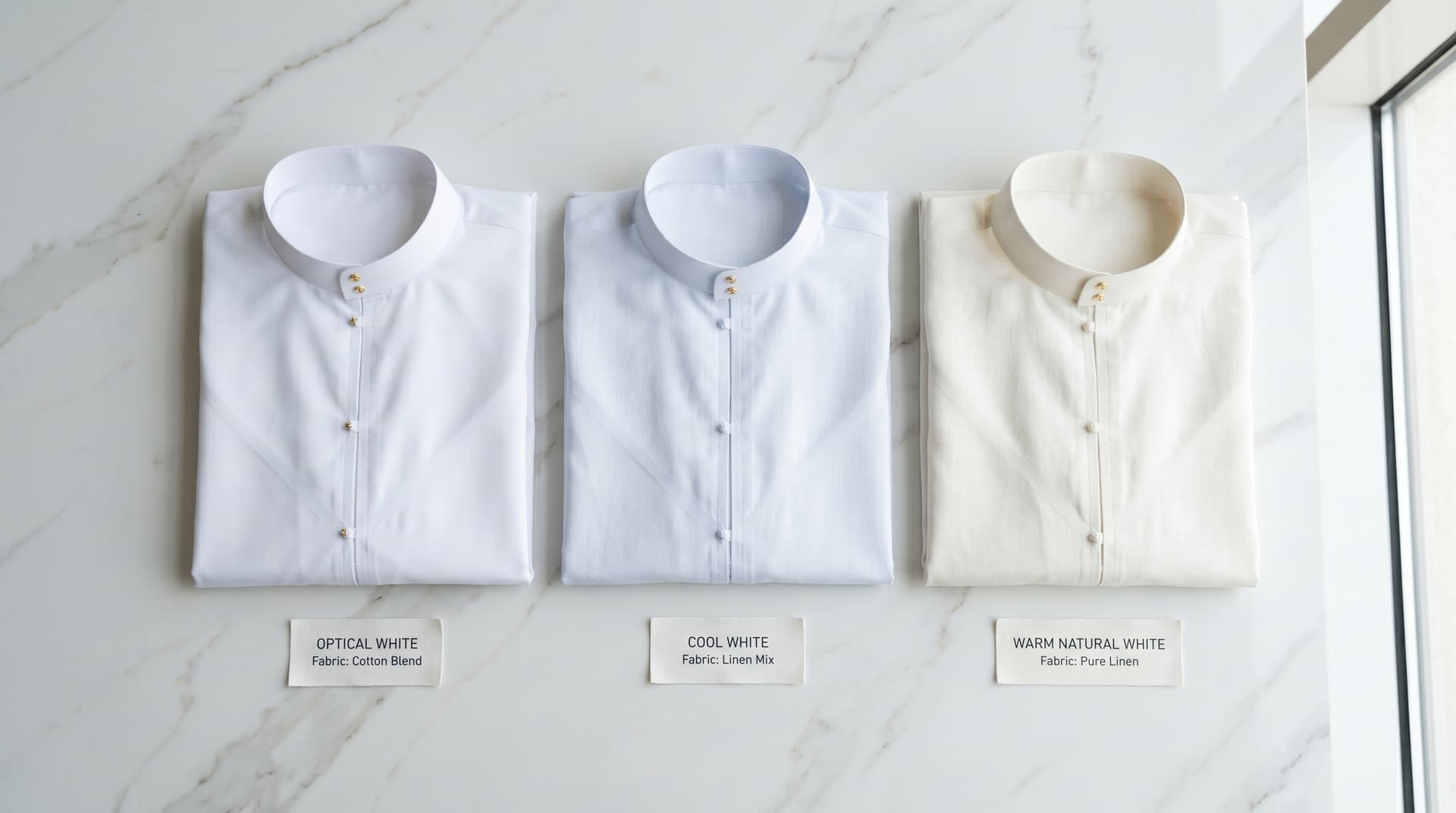
Optical white — sometimes called fluorescent white or bright white, is fabric that has been treated with optical brightening agents during the finishing process. These agents absorb ultraviolet light and re-emit it as visible blue-toned light, making the fabric appear exceptionally bright and almost luminous, particularly in sunlight and under fluorescent lighting. This is the whitest-looking white available and it is what most people picture when they think of a crisp kandora.
Natural white — also called off-white or warm white — is fabric finished without brightening agents, allowing the natural color of the cotton fiber to show through. This produces a softer, slightly warmer tone that sits closer to cream than to pure white. It does not glow under UV light the way optical white does and reads as quieter and more muted in bright conditions.
Cool white sits between the two — brighter than natural white but without the full luminosity of optical white. It has a slight blue or grey undertone that gives it a clean, precise look without the intensity of fully brightened fabric.
Each of these reads differently against different skin tones, and choosing the wrong one creates a visual mismatch that is difficult to identify but impossible to ignore once you know it is there.
Understanding Your Own Skin Tone
Before choosing a fabric finish, you need a basic understanding of your own skin tone — not just how light or dark your complexion is, but what undertone it carries.
Skin undertones fall into three broad categories: warm, cool, and neutral.
- Warm undertones show yellow, golden, or olive tones beneath the surface of the skin. Men with warm undertones often tan easily and have veins that appear greenish at the wrist.
- Cool undertones show pink, red, or bluish tones beneath the surface. Men with cool undertones tend to burn more easily in the sun and have veins that appear blue or purple at the wrist.
- Neutral undertones are a mix of both warm and cool with no single dominant tone. Men with neutral undertones have more flexibility in what works against their skin because there is no strong undertone to clash with.
Knowing which category you fall into is the first step toward understanding which white fabric finish will work best for you.
Which White Works for Warm Skin Tones
Men with warm undertones — which includes a large proportion of South Asian, Arab, and Middle Eastern complexions, generally look best in whites that carry a warm or neutral tone rather than a cool or heavily brightened one.
Optical white with its blue-toned brightness can create a stark contrast against warm skin that reads as harsh rather than clean. The cool luminosity of the fabric pulls against the warmth of the skin tone in a way that can make the complexion look uneven or dull by comparison.
Natural white and warm white fabrics work much better here. The slight warmth in the fabric tone complements rather than fights the warmth in the skin, creating a harmonious combination where neither the fabric nor the complexion is fighting for visual dominance. The result is a kandora that looks like it belongs on the person wearing it.
For men with medium to deep warm skin tones, a natural white kandora in a fabric with good drape and a smooth surface finish often produces a more polished and expensive-looking result than the brightest optical white available, even if the optical white looks more impressive on the hanger.
Which White Works for Cool Skin Tones
Men with cool undertones — which includes many lighter-complexioned men from European, East Asian, and some Middle Eastern backgrounds — generally handle optical white and cool white fabric better than those with warm undertones.
The blue-toned brightness of optical white does not clash with a cool undertone the way it does with a warm one. Instead, it creates a clean, high-contrast look that reads as sharp and deliberate. The luminosity of the fabric complements rather than competes with the cooler tones in the skin.
Natural white and warm white can work for cool undertones in some cases — particularly for men with very fair skin where the contrast of optical white feels too intense — but in general, cooler and brighter fabric finishes are more flattering for this group.
Cool white sits in a comfortable middle ground for men with lighter cool undertones who want brightness without the full intensity of optical white. It is a practical choice for daily wear where you want to look clean and sharp without the optical white's tendency to attract attention.
Which White Works for Neutral Skin Tones
Men with neutral undertones have the most flexibility. Both warm and cool fabric finishes can work, and the choice becomes more about occasion and personal preference than about avoiding a specific tonal clash.
For daily wear, a natural or cool white offers a versatile finish that works across different lighting conditions, indoors and outdoors, in summer sun and winter shade. For formal occasions where maximum visual impact matters, optical white delivers the brightness and presence that a high-formality setting calls for.
Men with neutral undertones who are unsure where to start can use optical white as their formal kandora fabric and natural or cool white for daily wear — a practical division that covers both ends of the wardrobe without requiring a deep dive into undertone analysis for every purchase.
How Lighting Changes Everything
One factor that complicates skin tone and fabric matching is that lighting conditions dramatically affect how both appear. A kandora that looks perfect in the soft warm light of a tailoring shop may read very differently under the harsh fluorescent lighting of an office building or in direct midday Abu Dhabi sunlight.
Optical white fabric is most dramatically affected by lighting shifts. In natural sunlight it can appear almost luminous — genuinely impressive and visually striking. Under warm indoor lighting, the same fabric may lose some of its brightness and take on a flatter quality. Under fluorescent lighting, the optical brightening agents activate fully and the fabric glows with a cool intensity.
Natural white is more consistent across lighting conditions. It does not peak dramatically in bright sunlight the way optical white does, but it also does not drop off in warm indoor light. For men who move between different lighting environments throughout the day, as most professionals in Abu Dhabi do — this consistency is a practical advantage.
When choosing fabric for a kandora, try to evaluate it in at least two different lighting conditions before committing. Take it to a window and look at it in natural light, then look at it under the shop's indoor lighting. The difference between the two tells you a lot about how it will perform across the conditions you actually wear it in.
The Role of Fabric Surface in How Color Reads
Beyond the white tone itself, the surface finish of the fabric affects how color reads against the skin. A fabric with a slight sheen reflects light and appears brighter than a matte fabric of the same white tone. A textured surface scatters light and can make white appear slightly softer and less intense.
For men who find optical white too stark against their skin but want a bright, clean finish, a fabric with a very slight sheen in a cool white or natural white can bridge the gap. The sheen adds visual brightness without the blue-toned intensity of optical brightening, creating a look that is polished without being harsh.
Matte fabrics in natural white are the softest-looking option across all skin tones and work particularly well for daily wear where a quieter, more understated appearance is the goal.
Getting It Right in Person
Reading about undertones and fabric finishes is useful context, but the most reliable way to find the right white for your skin tone is to hold actual fabric swatches against your skin in good lighting and observe the difference directly.
When you visit a tailor, ask specifically to compare fabric swatches in different white finishes side by side against your forearm in natural light. The difference between how optical white, cool white, and natural white read against your skin is immediately visible when you see them together, even if you could not have described the distinction before looking.
A good tailor will guide this process and offer a recommendation based on your specific complexion. This is part of what a proper tailoring consultation includes, not just taking your measurements but helping you make choices that produce a finished kandora that genuinely works for you as an individual.
Browse the full range of premium white kandoras for men at Shabab Al Yola to get a sense of the fabric options available before your appointment, and come in ready to compare swatches in person.
The Right White Makes the Whole Look Work
A kandora that is the wrong shade of white for your skin tone does not look dramatically wrong, it just never quite looks right. The complexion seems slightly off, the overall appearance lacks the crispness you were aiming for, and the garment never fully delivers on what it promised in the shop.
Fixing this is not complicated once you understand what to look for. The right fabric finish for your specific undertone turns a kandora from something you wear into something that genuinely works for you, and that difference is visible every time you put it on.